
Smoke & Fire Curtains
THS began weaving operations in 1985, initially focusing on glass fibre products for use in composites. However, as market demand shifted, particularly with the rise of E-glass as a safer alternative to asbestos, we expanded our reach into a broader range of industries. This included sectors such as oil and gas, thermal insulation and welding protection.
As our expertise in weaving and coated fabrics grew, wire-reinforced E-glass fabrics became a core product at THS. These fabrics ranged in weight from 500gsm to over 1000gsm and quickly became a regular feature in our production line.
Over time, we developed a diverse portfolio of fabric variations. These included innovative weave patterns, the use of high-spec stainless steel (SS) yarns and precise control over the glass to wire twist ratios in the yarns. We also adjusted the percentage of stainless steel yarn used in both the warp and weft to enhance overall fabric integrity.
With these advanced capabilities, it was a natural progression for us to serve highly demanding applications, most notably the Smoke and Fire Curtain market.
What Are Fire and Smoke Curtains?

Fire safety is a critical aspect of modern building design and regulation. Among the key safety systems in place are fire and smoke curtains, which are essential for controlling the spread of flames and smoke during a fire emergency.
A fire curtain is a flexible, fire-resistant barrier that can be installed either vertically or horizontally to divide large spaces or buildings into smaller compartments. Its primary function is to slow the spread of fire, giving occupants more time to evacuate safely and allowing emergency services to respond more effectively.
Fire curtains are typically activated by a building’s fire alarm system and are available in two main types:
Standard Fire Curtains
- Designed to stop the spread of flames
- Do not provide thermal insulation or smoke resistance
- Ideal for compartmentation in non-evacuation areas
Insulated Fire Curtains
- Offer both flame resistance and thermal insulation
- Reduce radiant heat transmission
- Often include smoke seals to block smoke movement
- Crucial for protecting escape routes and safe corridors
While similar in appearance, smoke curtains serve a different purpose. These are designed specifically to channel smoke toward extraction systems, such as Smoke and Heat Exhaust Ventilation Systems (SHEVS), helping to maintain clearer escape paths and improve visibility during evacuation.
Categorising Fire Curtain Performance
Fire curtains are classified according to three key performance criteria: integrity, radiation and insulation. Each criteria is represented by a letter followed by a number, indicating the duration (in minutes) that the curtain has successfully met the specified standard. For example, ratings such as 15, 30, 60, 90, 120, 180 and 240 correspond to the number of minutes the curtain has been tested and certified to perform effectively under those criteria.
Integrity (E)
This refers to the ability of the fire curtain to maintain its structural integrity without developing gaps or tears when exposed to heat. Fire curtains are tested in a furnace, where the temperature can exceed 1000°C. The integrity rating indicates the duration for which the curtain remains intact without any surface flaming for more than 10 seconds.
Radiation (W)
This measures the thermal energy passing through the fire curtain. A radiation rating is determined by placing a probe 1 meter away from the curtain and measuring the energy given off in kW/m2. The curtain must not exceed a certain threshold (usually 15 kW/m2) within a specified time frame to achieve the radiation rating.
Insulation (I)
Insulation refers to the ability of the fire curtain to maintain a low surface temperature on the non-fire side. Multiple temperature probes are attached to the curtain and the average surface temperature must not exceed a certain level (typically 140°C) while avoiding hot spots greater than 180°C. Achieving an insulation rating also contributes to reducing radiation.
Materials and Testing Standards
To ensure the effectiveness and safety of fire curtains, the materials used in their construction undergo rigorous testing. Meeting these testing standards ensures that fire curtains meet the necessary safety requirements for use in buildings. Two main standards commonly applied are BS 476-1 and BS EN 13501-1.
For more details on the thorough testing processes we apply to our fabrics, please visit our Fire Protective Textiles page.
Pioneers in Fire Curtain Fabrics
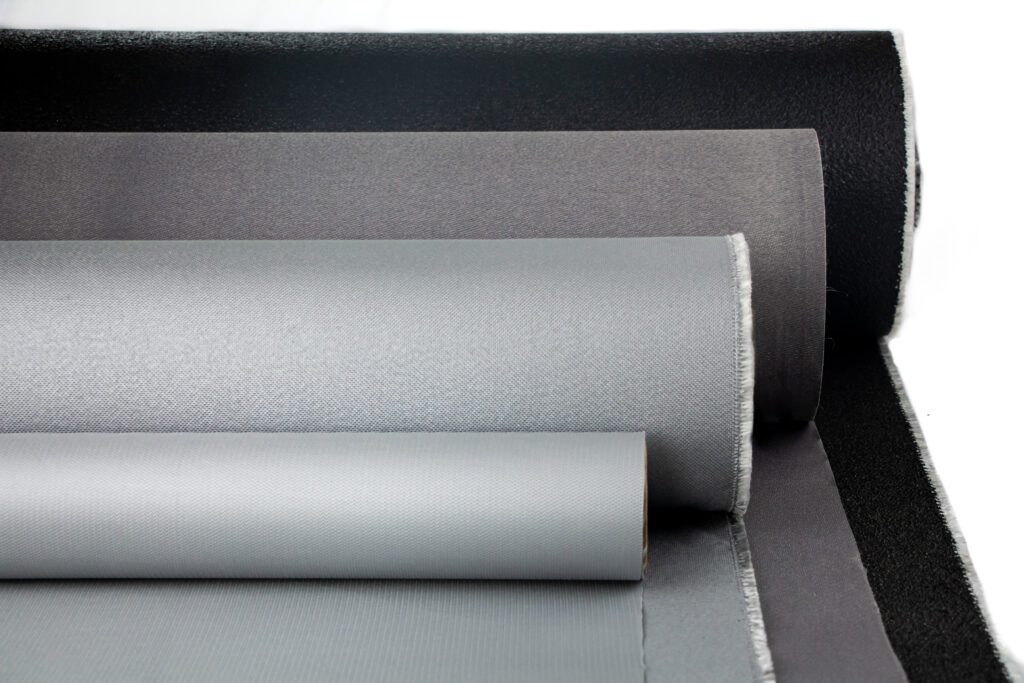
While the base fabric is the core of any fire curtain, the real performance lies in the specialist coatings. At THS, we’ve invested extensively in R&D to develop coatings that achieve industry-leading fire resistance ratings. Our fabrics are coated with:
- FR Polymers
- Intumescent compounds
- Vermiculite
- Silicone compounds
These fabric combinations enable our products to achieve integrity ratings ranging from 60 to 240 minutes, all certified through independent testing.
Our top-performing fire curtain fabric has demonstrated outstanding durability, maintaining its integrity for an impressive 240 minutes (4 hours) in a test furnace with temperatures exceeding 1000°C*. This exceptional resistance makes THS fire curtain fabrics an ideal choice for applications demanding the highest fire safety standards.
Investing in fire curtains is a critical step toward ensuring a safe and secure environment. With THS Industrial Textiles at the forefront of fabric innovation, building owners and occupants can have complete confidence that their fire safety needs are met with premium, rigorously tested products.
*After such exposure the fabric is not reusable.